
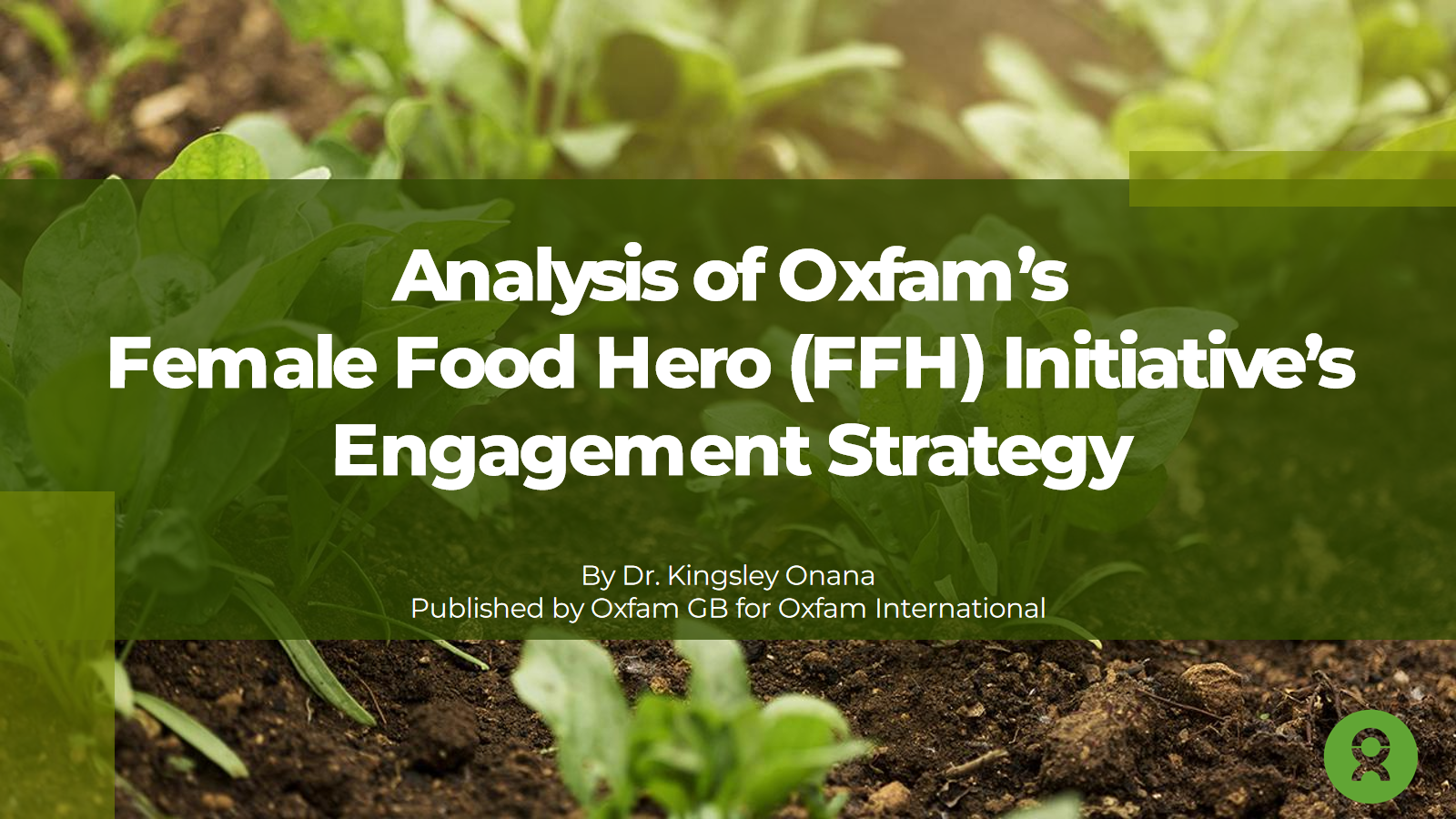
Last year, an evaluation was conducted on Oxfam’s Female Food Heroes Initiative in Nigeria, locally known as Ogbonge Women. Published by Oxfam Great Britain for Oxfam International, the study provides a critical look at how recognition, when combined with sustained support, can reshape women’s roles in agriculture and rural development.
Why this matters
Across much of the Global South, women are central to food production, yet their contributions remain undervalued and under-resourced. Initiatives like Female Food Heroes attempt to shift that imbalance by doing something deceptively simple: making women farmers visible.
Since its launch in 2012, the programme has gone beyond celebration. It has created pathways for women to access training, financial tools, leadership opportunities, and policy engagement platforms.
The underlying premise is clear. Recognition is not symbolic. It is strategic.
What the evaluation found
The findings point to meaningful and measurable impact.
First, the initiative has strengthened women’s participation in agriculture. Through mechanisms such as Village Savings and Loan Associations and sustainable farming training, women have expanded their economic opportunities and improved productivity.
Second, it has built leadership capacity. Participants are not just farmers. They become advocates, mentors, and visible actors within their communities and beyond.
Third, it has shifted perception. By elevating women as “food heroes,” the programme challenges entrenched gender norms and repositions women as central to food security and rural transformation.
What emerges is a multiplier effect. When women gain recognition and access, they influence households, communities, and local systems.
The limits of recognition alone
However, the evaluation does not romanticize the model.
Several structural and operational gaps continue to constrain long-term impact.
Funding remains inconsistent. Staffing structures are often weak. Follow-up engagement with awardees is limited. Monitoring, evaluation, and learning systems are underdeveloped.
Beyond programme design, deeper systemic barriers persist. Women continue to face restricted access to land, limited financial inclusion, and entrenched cultural norms that shape what is possible in practice.
The implication is straightforward. Recognition opens doors, but it does not keep them open.
What needs to change
The report makes a strong case for moving from episodic recognition to sustained transformation.
This includes investing in continuous capacity building, strengthening alumni networks, and embedding gender-transformative approaches that address power, not just participation.
It also calls for stronger collaboration across government, civil society, and private sector actors, alongside more robust monitoring systems and diversified funding models.
At a broader level, the programme must evolve from highlighting individual champions to enabling collective impact.
Looking ahead
This evaluation is part of a wider effort to assess the Female Food Heroes model across contexts, including a comparative study in Ethiopia. Together, these studies provide a clearer picture of both the promise and the limits of recognition-based development approaches.
The takeaway is not that the model falls short. It is that it is incomplete.
With the right investments and structural adjustments, initiatives like Female Food Heroes can move beyond visibility toward lasting systems change.
Final thought
What this work ultimately shows is simple but important. When women farmers are seen, supported, and connected to systems of power, the impact extends far beyond agriculture.
It reshapes livelihoods. It shifts norms. It builds more inclusive food systems.
The question now is whether programmes and partners are willing to match that potential with sustained commitment.




0 Comments